
From chip acquisitions to sovereign AI programs, the U.S. tech sector is realizing that dominance in artificial intelligence depends on far more than algorithms.
For the last several years, the artificial intelligence race looked like a battle of benchmarks. Which model scored highest on standardized tests? Which company released the most impressive demo? That framing still captures some public attention, but it has become increasingly disconnected from where the real competition is now unfolding. In 2026, the fight for AI supremacy has shifted toward infrastructure: the chips that run models, the energy grids that power data centers, the talent pipelines that sustain research, and the geopolitical arrangements that determine who can access what. The United States still leads — but the margin is narrower than it looks, and the pressure points are multiplying.
According to Stanford University’s 2026 AI Index Report, the U.S. still produces more top-tier AI models and higher-impact patents, while China leads in publication volume, citations, patent output, and industrial robot installations. As of March 2026, Anthropic’s top model leads its closest Chinese competitor by just 2.7%. That gap, barely measurable in technical terms, carries enormous strategic weight — and it is driving decision-making across government, industry, and investment circles in ways that are just beginning to become visible. Stanford HAI
The Infrastructure Gap Is Becoming the Real Battlefield
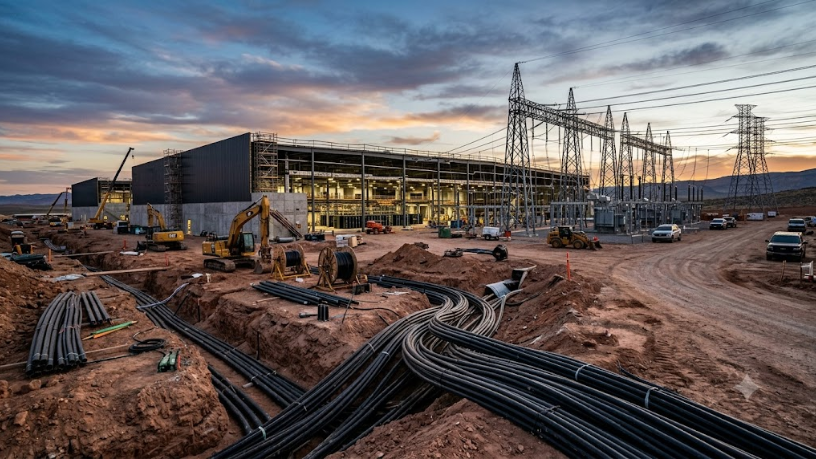
The scale of capital flowing into AI infrastructure is staggering. U.S. technology giants have committed an estimated $700 billion to data center construction in 2026 alone, but their plans are colliding with major supply-chain and energy grid constraints. That bottleneck is not a technical problem awaiting a technical fix. It is a systemic challenge that involves power generation, zoning policy, cooling water access, and semiconductor availability — none of which Silicon Valley can solve on its own. devFlokers
On the chip side, consolidation is accelerating. Qualcomm is in early talks to acquire Tenstorrent for between eight and ten billion dollars, which would give it real seats at the AI hardware table currently dominated by Nvidia and AMD. Tenstorrent designs AI chips using the open RISC-V standard and features the engineering expertise of chip veteran Jim Keller. This acquisition, if completed, would mark one of the most significant structural shifts in the AI chip market in years — a direct challenge to Nvidia’s near-monopoly on the compute that large language models require to train and run. Crescendo AI
Meanwhile, research is targeting the hardware itself. Researchers at the University of Pennsylvania have created a hybrid light-matter particle that could dramatically speed up AI computing while using far less energy, potentially replacing some electronic computing processes with ultra-efficient light-based alternatives. That development is still far from commercial deployment, but it points toward a future where the energy crisis threatening today’s data center expansion could eventually be addressed at the hardware level. ScienceDaily
Sovereignty, Regulation, and the Limits of American Dominance
The most consequential shift in the global AI landscape may not be technological at all. It is political. On June 19, 2026, the European Commission selected the EUROPA Consortium, led by Italian enterprise Domyn, as the winner of its Frontier AI Grand Challenge. Supported by a dedicated 6,000-chip NVIDIA Blackwell cluster and up to 2.5% of EuroHPC’s high-performance supercomputing capacity, the consortium is tasked with building a sovereign, open-source model exceeding 400 billion parameters, trained natively across all 24 official EU languages. The message to Washington and to Silicon Valley is clear: Europe is no longer content to consume AI built elsewhere on terms set by others. devFlokers
This sovereign impulse is not limited to Europe. The number of AI scholars moving to the United States has dropped 89% since 2017, undermining the talent pipeline that has historically given American labs a decisive edge. That figure, published in the Stanford AI Index, reflects broader immigration policy pressures and a growing sense among international researchers that opportunities now exist at home or in other jurisdictions. Stanford HAI
The regulatory environment is also fragmenting in ways that create new friction for American AI companies operating globally. The estimated value of generative AI tools to U.S. consumers reached $172 billion annually by early 2026, with the median value per user tripling between 2025 and 2026. But capturing that value across international markets requires navigating an increasingly complex patchwork of data localization rules, content regulations, and export controls — including, notably, an export-control directive issued by the U.S. government in June 2026 that barred access to certain advanced AI models by foreign nationals, a move that affected global access in ways the industry had not fully anticipated. Stanford HAIdevFlokers
Where the Next Phase of AI Competition Is Headed
The pattern emerging from 2026 suggests that the AI industry is entering a phase of consolidation and geopolitical realignment rather than unconstrained expansion. By 2026, innovation is rapidly shifting toward post-training techniques, where companies are dedicating an increasing portion of their compute resources — meaning the focus is no longer on sheer model size, but on refining and specializing models with techniques like reinforcement learning to make them more capable for specific tasks. That shift favors well-resourced incumbents who can afford sustained post-training compute, but also opens doors for specialized players with unique proprietary data. InfoWorld
The environmental stakes are rising alongside the competitive ones. Grok 4’s estimated training emissions reached 72,816 tons of CO2 equivalent, and AI data center power capacity has risen to 29.6 GW — roughly what it takes to power the entire state of New York at peak demand. Those numbers are becoming harder for the industry to ignore as public scrutiny intensifies and utilities resist building new generation capacity primarily to serve AI workloads. Stanford HAI
The U.S. still leads. But the margin is shrinking, the infrastructure constraints are real, and the geopolitical environment is creating friction that no algorithm can optimize away. The companies and governments that understand this are already thinking beyond the next model release.
Sources:
- Stanford HAI — https://hai.stanford.edu/news/inside-the-ai-index-12-takeaways-from-the-2026-report
- Crescendo AI — https://www.crescendo.ai/news/latest-ai-news-and-updates
- ScienceDaily — https://www.sciencedaily.com/news/computers_math/artificial_intelligence/
- DevFlokers — https://www.devflokers.com/blog/ai-tech-news-model-releases-june-2026
Autor: Diego Rodríguez Velázquez