
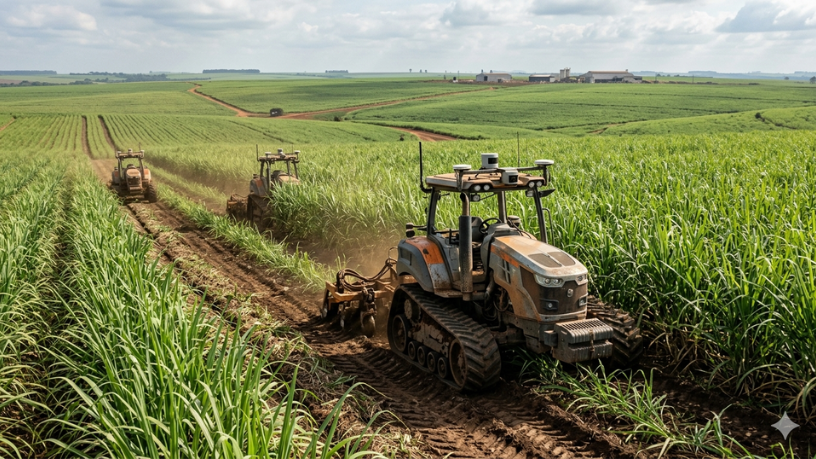
The rapid expansion of autonomous tractors in the United States sugar industry highlights a major transformation taking place across global agriculture. What was once considered futuristic technology is now becoming part of everyday farming operations, especially in large scale agricultural sectors that demand efficiency, precision, and continuous productivity. The integration of artificial intelligence into agricultural machinery is not only changing how farms operate, but also reshaping the future of food production, labor management, and environmental sustainability.
As the agricultural sector faces increasing pressure to produce more with fewer resources, automation has emerged as one of the most important solutions for modern farming challenges. Autonomous tractors are designed to perform essential agricultural tasks with minimal human intervention. Using GPS systems, sensors, cameras, and machine learning software, these vehicles can navigate fields, optimize routes, and execute repetitive operations with high accuracy.
The sugar industry has become one of the strongest examples of this technological transition because sugarcane farming depends heavily on large areas of cultivation and highly organized operations. Delays, fuel waste, and inefficient field management can significantly impact profitability. By adopting autonomous machinery, producers are improving operational consistency while reducing unnecessary costs and increasing productivity.
One of the biggest advantages of autonomous tractors is efficiency. Unlike traditional farming equipment that depends entirely on human operators, autonomous systems can work longer hours with greater precision and fewer interruptions. This allows agricultural companies to maximize productivity during critical planting and harvesting periods, especially when timing directly affects crop quality and financial results.
Another important factor driving agricultural automation is the growing labor shortage affecting rural areas in many countries. Younger generations are increasingly moving away from physically demanding agricultural jobs, creating long term workforce challenges for producers. As a result, companies are investing in technology capable of maintaining production levels even with fewer available workers.
The expansion of intelligent farming technology also reflects broader economic changes within agribusiness. Modern agriculture is no longer based solely on physical labor and machinery. It now depends heavily on data analysis, connectivity, artificial intelligence, and digital management systems. Farms are becoming highly technological environments where operational decisions are guided by real time information and automated processes.
Beyond productivity gains, autonomous tractors offer important environmental benefits. Precision technology allows machines to use fuel more efficiently while reducing soil damage and minimizing waste in the application of fertilizers and agricultural chemicals. These improvements support sustainable farming practices, which have become increasingly important as governments, investors, and consumers demand more environmentally responsible food production systems.
Sustainability is now one of the central priorities in global agriculture. Large agricultural companies face growing pressure to reduce emissions, improve resource management, and operate with greater environmental transparency. In this context, automation is not simply a tool for increasing profits. It is also becoming a critical strategy for long term sustainability and regulatory adaptation.
However, the rapid growth of agricultural automation also raises important social concerns. While new technologies create opportunities in technical and digital sectors, they may also reduce demand for traditional farming positions. This transition could reshape rural employment markets and force many workers to develop new technological skills in order to remain competitive.
The challenge for the agricultural industry is balancing innovation with workforce adaptation. Training programs and educational investments will become increasingly necessary as farms continue integrating advanced machinery and artificial intelligence into daily operations. The future agricultural worker may spend less time operating equipment manually and more time supervising digital systems and analyzing production data.
Cost remains another major issue. Autonomous tractors and smart farming systems require substantial initial investment, making them more accessible to large agricultural corporations than to small producers. This could increase inequality within the farming sector, where highly automated companies gain significant advantages over smaller farms with limited financial resources.
Despite these challenges, many experts believe agricultural technology will become more affordable as innovation expands and competition among manufacturers increases. Similar patterns have occurred in other industries where advanced technologies eventually became accessible to a wider market. Over time, autonomous farming equipment may become standard across multiple agricultural sectors.
The large scale deployment of autonomous tractors in the sugar industry represents more than a technological milestone. It signals a broader transformation in how agriculture will function in the coming decades. Farming is becoming increasingly automated, data driven, and strategically connected to artificial intelligence.
As global food demand continues rising alongside environmental and economic pressures, technological innovation is quickly becoming essential for agricultural survival. Autonomous tractors are not simply modern machines operating in fields. They are symbols of a new era where efficiency, sustainability, and digital intelligence define the future of global farming.
Autor: Diego Velázquez