

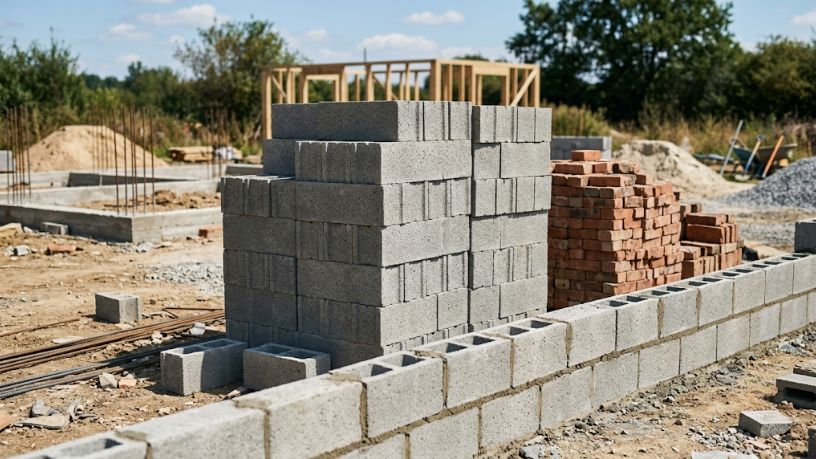
According to Eng. Valderci Malagosini Machado, Technical Director at Blocos e Lajes Itaim, the choice of structural material directly influences the quality, timeline, and overall cost of a construction project, making it one of the most important considerations during the planning of residential and commercial developments. Concrete blocks have become an increasingly established technical alternative to other structural materials available on the market.
Among the key factors considered when selecting a structural material are mechanical strength, dimensional consistency, ease of transportation, and construction speed—areas in which concrete blocks consistently deliver strong performance. Comparing different structural materials becomes especially important in large-scale projects, where even small differences in performance can have a significant impact throughout the construction process.
What Technical Characteristics Set Concrete Blocks Apart?
Concrete blocks are manufactured under strict quality controls for material proportions and curing processes, ensuring superior mechanical strength and dimensional consistency compared to products made through traditional or handcrafted manufacturing methods. Eng. Valderci Malagosini Machado explains that this level of standardization minimizes variations between production batches, making structural planning and on-site installation more efficient.
The ability to manufacture concrete blocks in various sizes and technical specifications also expands their application in structural masonry, industrialized building systems, and interlocking concrete pavement. This versatility allows concrete blocks to be used in a wide range of projects, from affordable housing developments to highly complex commercial and infrastructure projects.
How Do Concrete Blocks Compare to Other Structural Materials?
Compared with traditional construction methods, such as conventional masonry built one unit at a time, concrete blocks reduce installation time and lessen the dependence on highly specialized labor for each stage of construction. Eng. Valderci Malagosini Machado identifies this advantage as one of the main reasons why real estate developers have increasingly adopted industrialized construction systems for large-scale projects.
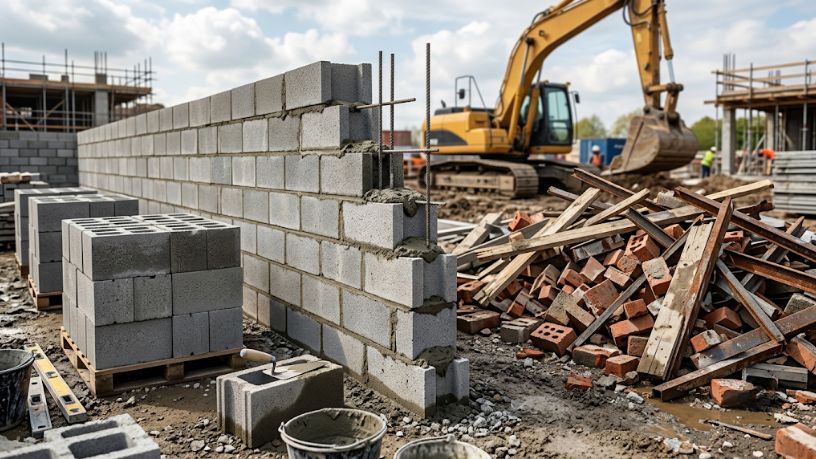
Other structural materials, while appropriate for specific applications, often require additional finishing or reinforcement processes that concrete blocks eliminate in many situations. This difference translates directly into higher productivity on construction sites and greater predictability in project scheduling.
Why Does the Durability of Concrete Blocks Matter for Investment?
The durability of a structural material has a direct impact on a building’s long-term maintenance costs, making it a critical consideration for both real estate development and affordable housing projects. Eng. Valderci Malagosini Machado notes that the resistance of concrete blocks to weather conditions and mechanical stress significantly reduces the need for corrective maintenance over the decades following project completion.
Long-term performance also contributes to sustainability in construction, since more durable structures require fewer resources for repairs and replacements. The combination of construction efficiency and lasting durability reinforces the role of concrete blocks as a well-established technical solution within the construction industry.
What Is the Economic Impact of Choosing Concrete Blocks for Large-Scale Developments?
The selection of structural materials has a direct effect on the financial viability of a project because acquisition costs must be evaluated alongside construction speed and future maintenance requirements. Eng. Valderci Malagosini Machado points out that concrete blocks often offer a competitive total project cost when the entire life cycle of a development is considered, rather than focusing solely on the initial purchase price of the material.
In real estate developments and urban construction projects, this total-cost perspective supports more informed decisions about the most appropriate structural material for each application. The productivity gains achieved through industrialized construction systems further strengthen the position of concrete blocks as a technically competitive solution in today’s construction market.