
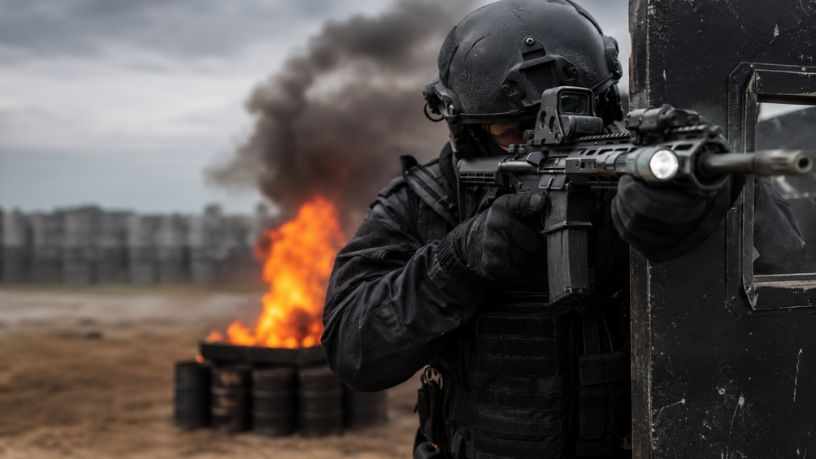
As highlighted by Ernesto Kenji Igarashi, creator of the Weapons and Shooting Group of the Federal Police Superintendence in São Paulo, executing a technique precisely at a shooting range or in a controlled training environment is one skill. Executing that same technique in a real high-risk situation, with a racing heart, tense muscles, narrowed vision, and a mind processing multiple threats simultaneously, is an entirely different competence. The distance between these two states is what separates the technically trained operator from the truly prepared operator.
Read through to the end of the content to learn more!
What happens to an operator’s body and mind during a high-stress situation?
When the nervous system detects a real or perceived threat, the body initiates a cascade of physiological responses shaped over millions of years of evolution to maximize the chances of survival. Adrenaline and cortisol are released in significant amounts, heart rate increases abruptly, blood flow is redirected to large muscle groups, vision narrows to focus on the immediate threat, and higher-order cognitive processing — the type responsible for strategic reasoning and complex decision-making — is partially suppressed in favor of automatic responses.
According to Ernesto Kenji Igarashi, this state is highly functional for survival in primitive situations. However, in modern tactical operations, where rational decision-making, precise team communication, and controlled technical execution are decisive factors, many of these automatic responses work against the operator. The degradation of fine motor skills, which makes equipment handling more difficult, tunnel vision, which reduces peripheral awareness of threats and allies, and impairment of working memory, which interferes with the execution of learned procedures, are the main internal adversaries an operator faces in the field.
What makes this condition especially challenging is that it cannot simply be suppressed through willpower or intellectual awareness of what is happening. The stress response is involuntary and systemic. The only way to functionally modify it is through progressive conditioning — that is, repeated and structured exposure to increasingly stressful situations that allow the nervous system to develop responses better adapted to the specific operational context.
What principles form the foundation of effective training for high-risk situations?
As explained by Ernesto Kenji Igarashi, former coordinator of the Federal Police tactical team, the first principle is stress specificity. Training under generic pressure, such as timed shooting drills or intense physical exercises before tactical sequences, has limited value if the stressor does not resemble the real operational conditions for which the operator is being prepared. The most effective training is the kind that progressively replicates the specific stress elements that will be encountered in the real environment: noise, cognitive load, threat ambiguity, the presence of other individuals in the area, and the need for simultaneous communication with the team.
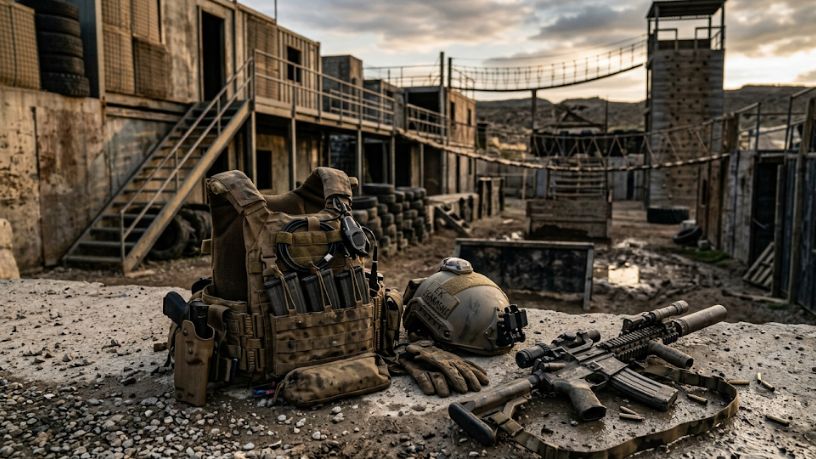
The second principle is intentional cognitive load. In real high-risk situations, the operator rarely deals with a single task at a time. They must maintain situational awareness, process environmental information, communicate with the team, assess threats, and execute technical procedures simultaneously. Training each of these capabilities in isolation creates compartmentalized skills that often fail to integrate under real pressure. Advanced training must deliberately combine multiple simultaneous demands, progressively increasing the cognitive complexity of the scenarios.
The third principle is stress inoculation, a concept developed from military psychology research demonstrating that controlled and progressive exposure to high-stress situations reduces the magnitude of the physiological response during subsequent exposures and improves the ability to maintain performance. According to institutional security and authority protection specialist Ernesto Kenji Igarashi, this effect does not eliminate the stress response — which would actually be counterproductive — but instead calibrates the body to operate efficiently within that state, rather than being paralyzed by it.
How do elite units structure training for performance under adrenaline?
High-performance units around the world share certain common characteristics in their training approach that go beyond technical repetition. One of them is the systematic use of force-on-force scenarios, in which operators face real opponents using simulation equipment in environments that reproduce the physical and cognitive conditions of actual operations. This type of training is incomparably more effective for developing decision-making under stress than unilateral exercises against static targets.
Finally, Ernesto Kenji Igarashi highlights another common practice: the integration of psychophysiological regulation protocols into operational training. Controlled breathing techniques, such as tactical breathing with defined cycles of inhalation, retention, and exhalation, have documented effectiveness in reducing heart rate during acute stress situations and maintaining cognitive processing capacity. Operators who master these techniques possess a concrete tool for modulating the stress response in real time during operations.
Author: Diego Rodríguez Velázquez