


According to Cristiane Ruon dos Santos, a sewing studio can be organized in a functional way even with a limited budget. This is because many professionals start small productive spaces by making use of home environments, basic equipment, and smart planning to reduce waste right from the beginning of the operation.
With this in mind, throughout this content, the main equipment, ways to organize the space, cost-saving strategies, and alternatives that help make the studio more efficient from the start will be presented. Therefore, keep reading and understand how to turn a small investment into a productive and functional structure.
How to Set Up a Sewing Studio at Home?
Setting up a sewing studio at home reduces important expenses related to rent, transportation, and adapting a commercial space. According to Cristiane Ruon dos Santos, starting at home allows more resources to be directed toward truly necessary equipment, avoiding impulsive spending on decoration or excessive structure.
The choice of environment directly influences productivity. Even a small room can work well when there is good lighting, proper ventilation, and smart organization. In fact, as demand grows, it becomes easier to gradually expand the structure without compromising the business’s cash flow.
Another relevant point involves separating the workspace from the household routine, as highlighted by Cristiane Ruon dos Santos. Even in compact spaces, maintaining an exclusive area for production helps create operational discipline. In addition, it improves the storage of fabrics, threads, patterns, and tools, reducing losses and rework throughout the daily routine.
Which Equipment Is Essential in the Beginning?
The most common mistake made by those who want to open a sewing studio is buying too much equipment right at the start. Many items can be purchased later, as new services and specific production needs arise. In the initial phase, a few essential items are enough to ensure productivity and basic quality in the work. With that in mind, below are some of the most important pieces of equipment:
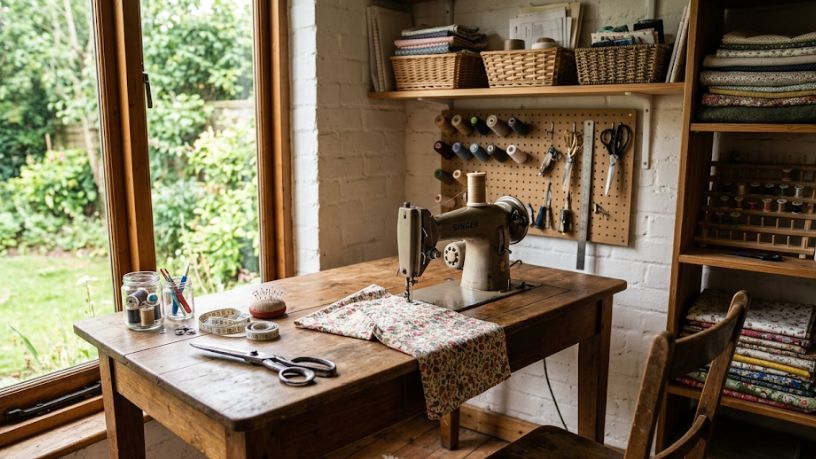
Straight stitch sewing machine: considered the main equipment for most basic services;
Overlock machine: important for finishing and improving the durability of produced pieces;
Work table: makes cutting, measuring, and organizing the workflow easier;
Specific scissors: proper fabric scissors increase precision and prevent material wear;
Iron: essential for professional finishing and better presentation of the garments;
Measuring tools: measuring tape, rulers, and tailor’s chalk help ensure precise adjustments.
After setting up the basics, it becomes much easier to identify which equipment truly makes sense for the chosen business model. This prevents unnecessary purchases and contributes to more balanced financial growth for the studio.
How to Organize a Small Production Space?
Even a compact sewing studio can convey professionalism when there is functional organization. The correct arrangement of equipment reduces unnecessary movement and improves the production pace throughout the day.
The ideal approach is to divide the space into small operational areas. A workstation for cutting, an exclusive area for sewing, and another for finishing make the routine more efficient. In addition, categorizing materials prevents wasting time searching for tools or fabrics during work.
Another important aspect involves vertical storage, as emphasized by Cristiane Ruon dos Santos. Niches, shelves, and organizing boxes help make use of walls and upper areas without compromising circulation. This strategy is especially useful for those working in apartments or reduced spaces.
Finally, lighting also deserves attention. According to Cristiane Ruon dos Santos, well-lit environments increase finishing precision and reduce visual fatigue. Therefore, whenever possible, natural light should be prioritized, complemented by directed lamps focused on sewing and cutting areas.
Strategies That Help the Sewing Studio Grow Sustainably
Ultimately, the sustainable growth of a sewing studio depends less on large investments and more on smart management. In this way, building a solid foundation from the beginning makes gradual expansion easier without compromising the financial health of the business. In addition, investing in personalized customer service can become an important competitive advantage.
In a market increasingly focused on exclusivity and customization, smaller sewing studios can build closer relationships and offer solutions tailored to each client’s needs. In other words, starting with a smaller structure can represent a strategic advantage, since a lean operation favors quick adaptation, lower financial exposure, and more consistent gradual growth.
Autor: Diego Rodríguez Velázquez