

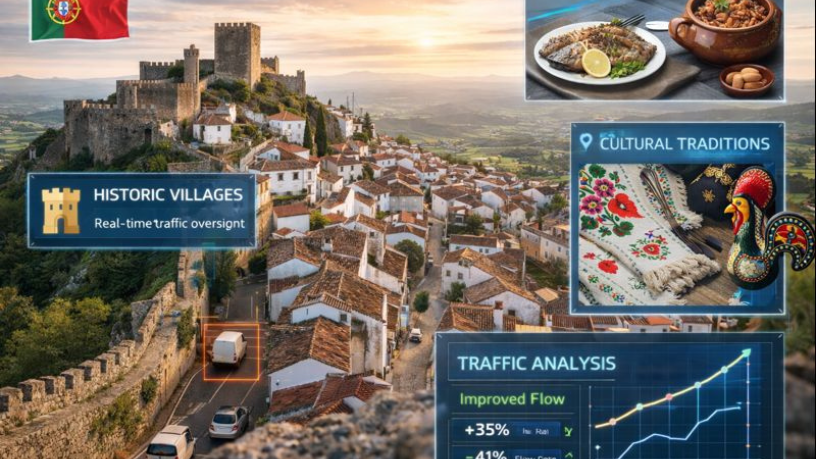
Portugal beyond Lisbon reveals a country that unfolds at a gentler pace, far from the intense flows of the capital. According to Leonardo Rocha de Almeida Abreu, it is in this less obvious Portugal that travelers find more authentic experiences, shaped by history, generous tables, and the preservation of traditions.
Portugal Beyond Lisbon and the Value of Historic Villages
Walking through Portuguese villages is like crossing centuries without haste. Óbidos, with its intact walls, seems suspended in time. Monsaraz, in Alentejo, gazes calmly over the horizon, while whitewashed houses reflect the intense southern light. As Leonardo Rocha de Almeida Abreu notes, these villages are not merely well-preserved settings but living spaces where history remains integrated into daily life.
In places like Guimarães or Viseu, the medieval past coexists with modern routines. Churches, squares, and castles continue to serve as gathering points. This continuity reinforces a sense of belonging and helps explain why Portugal’s cultural heritage remains so well cared for.
Regional Cuisine as Cultural Identity
Discovering Portugal beyond Lisbon inevitably leads to the table. Each region presents its own flavors, shaped by climate, soil, and local traditions. In the north, heartier dishes warm colder days. In the center, soups and convent-inspired recipes tell quiet stories. In Alentejo, bread, olive oil, and herbs take center stage.
As Leonardo Rocha de Almeida Abreu points out, regional Portuguese cuisine avoids excess. It values ingredients, preparation time, and memory. Eating at a family-run tavern often offers deeper cultural insight than a sophisticated restaurant. Flavor carries affection and continuity.
Traditions Preserved in Everyday Life
Moving away from the capital, travelers notice that many traditions remain alive not for tourism’s sake, but out of habit. Religious festivals, pilgrimages, and local fairs are part of village calendars. Handicrafts continue to be a source of income and identity for many communities.
As Leonardo Rocha de Almeida Abreu highlights, these practices endure because they still make sense to those who live there. They are not staged performances; they are genuine expressions of a culture that recognizes itself in its past. Attentive visitors quickly sense this difference and approach with greater respect.
A Slower Rhythm and Portuguese Hospitality
Time seems to behave differently in Portugal beyond Lisbon. Meals last longer. Conversations are not ruled by the clock. Hospitality appears in simple gestures, such as an invitation for coffee or a detailed explanation of local history.
This slower pace does not signal delay, but choice. It allows for observing details, hearing stories, and understanding contexts. For many travelers, this becomes one of the greatest attractions, precisely because it contrasts with the fast-paced life of major cities.
A Country Revealed in the Details
Exploring Portugal’s lesser-visited regions requires curiosity and openness. Small detours lead to unexpected viewpoints, family wineries, and nearly silent villages. As Leonardo Rocha de Almeida Abreu observes, it is in these moments that travel ceases to be mere movement and becomes lived experience.
The journey is built through details: local accents, unhurried meals, conversations with residents who know every stone in the street. All of this deepens understanding of the country and creates more lasting memories.
Understanding Portugal Beyond the Capital
Traveling through Portugal beyond Lisbon is accepting an invitation to depth. It is recognizing that the country is not limited to its capital, charming as it may be. Historic villages, regional cuisine, and preserved traditions form a rich and coherent cultural mosaic.
As Leonardo Rocha de Almeida Abreu emphasizes, those who choose this path return with a more complete perception of Portugal—one built with time, attention, and respect. And often, it is outside the major centers that a country’s true essence reveals itself most clearly.
Author: Eura Tymal