

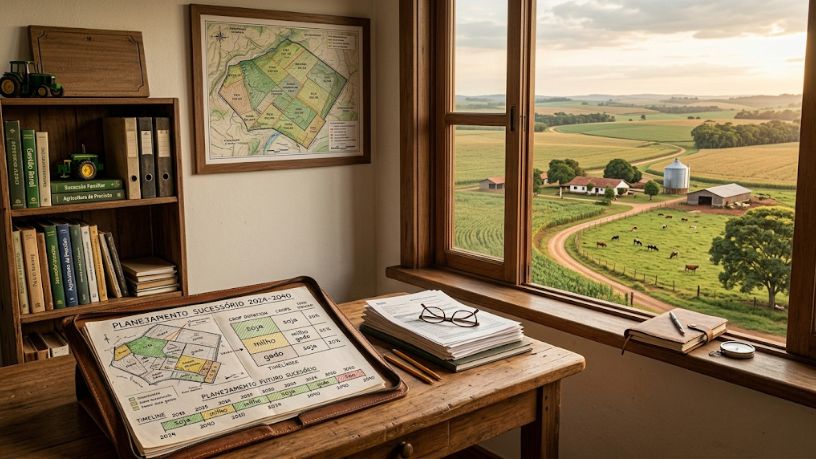
As Brazil’s agribusiness sector continues to evolve in terms of professionalization and operational scale, succession planning within family-owned rural properties has become an increasingly important topic for producers seeking to ensure the continuity of agricultural operations across generations while preventing leadership transitions from jeopardizing the farm’s financial or operational stability. Wander Aguilera Almeida, an agribusiness entrepreneur who closely follows this reality through agricultural business brokerage, often says that planning succession in advance is a strategic decision just as important as any other choice related to the commercial management of a rural property.
Why Has Succession Planning Become More Important in Agriculture?
The expansion of many Brazilian rural properties, combined with the growing complexity of commercial and financial operations involved in modern agriculture, has made the transfer of management between generations significantly more challenging than it was decades ago, when smaller farms and simpler operations naturally facilitated the handover of responsibilities. Wander Aguilera Almeida explains that producers managing larger-scale operations, involving multiple commercial contracts and long-standing relationships with buyers and financial institutions, must carefully consider how these relationships will be maintained throughout and after the succession process.
This increasing complexity also extends to estate planning and the distribution of assets among heirs, requiring advance preparation to prevent family disputes from disrupting the operational continuity of the farm during what is already a particularly sensitive period of generational transition.
How Can the Next Generation Be Prepared to Manage the Farm?
Properly preparing the next generation to take over the management of a rural property requires gradually involving future successors in commercial and operational decision-making, allowing them to develop practical knowledge of the business long before the actual transfer of leadership rather than assuming full responsibility without prior experience. Wander Aguilera Almeida points out that this gradual preparation, when carried out effectively over several years, generally results in a smoother and less disruptive transition for the farm’s commercial operations.
Investing in complementary technical education—whether through specialized agricultural management courses or hands-on experience alongside established professionals in the industry—also contributes significantly to helping the next generation develop the skills necessary to handle complex commercial negotiations, including relationships with brokers, institutional buyers, and financial institutions that already maintain long-standing partnerships with the farm.
What Commercial Factors Should Be Considered in Succession Planning?
Commercial relationships built over decades between producers and their primary buyers or brokers represent valuable assets that must be carefully preserved during the succession process, as a change in leadership may create uncertainty among business partners who have negotiated directly with the same individual for many years. Wander Aguilera Almeida emphasizes that gradually introducing the successor to these commercial partners before the leadership transition officially takes place helps preserve the trust built over time and reduces the risk of disrupting long-established business relationships.
Existing contracts, active lines of credit, and financial commitments undertaken by the farm must also be carefully mapped during succession planning, ensuring that the successor fully understands all ongoing obligations before assuming complete responsibility for the property’s commercial and financial management.
How Can Different Heirs’ Interests Be Balanced During the Transition?
Rural properties with multiple heirs often require careful planning to reconcile different interests and varying levels of involvement in agricultural activities, as not every heir necessarily wishes to take an active role in the farm’s day-to-day management. This may require tailored arrangements that fairly compensate all parties involved without compromising the efficiency of the commercial management carried out by those who actually oversee daily operations. Wander Aguilera Almeida notes that when these arrangements are formalized clearly and well in advance, they tend to significantly reduce family conflicts that could otherwise threaten the continuity of the farm’s productive activities.
Specialized legal and accounting guidance in rural estate succession is often recommended in these situations, helping to structure corporate or estate planning arrangements that properly reflect each heir’s interests while preserving the long-term operational viability of the agricultural property.
A broker who already maintains a well-established relationship with the rural property can also play an important role during the succession process by introducing the new manager to buyers and commercial partners while providing guidance on maintaining consistent business practices throughout the transition. Wander Aguilera Almeida often points out that this continuity in commercial brokerage, maintained during and after the succession process, helps preserve the stability of the farm’s negotiations even as leadership passes from one generation of the farming family to the next.